

Recognize 6 Types of Violence in Higher Education, Polibatam Promotes a Safe and Inclusive Campus
BATAM — Politeknik Negeri Batam (Polibatam) continues to promote a safe, comfortable, inclusive, equitable, and violence-free higher education environment. This effort reflects Polibatam’s commitment to implementing the values of Gender Equality, Disability, and Social Inclusion (GEDSI) across the campus community.
All members of the academic community are encouraged to recognize the various forms of violence that may occur, whether in person or through digital platforms. Understanding these forms of violence is essential so that every member of the campus community can help prevent, respond to, and report suspected incidents.
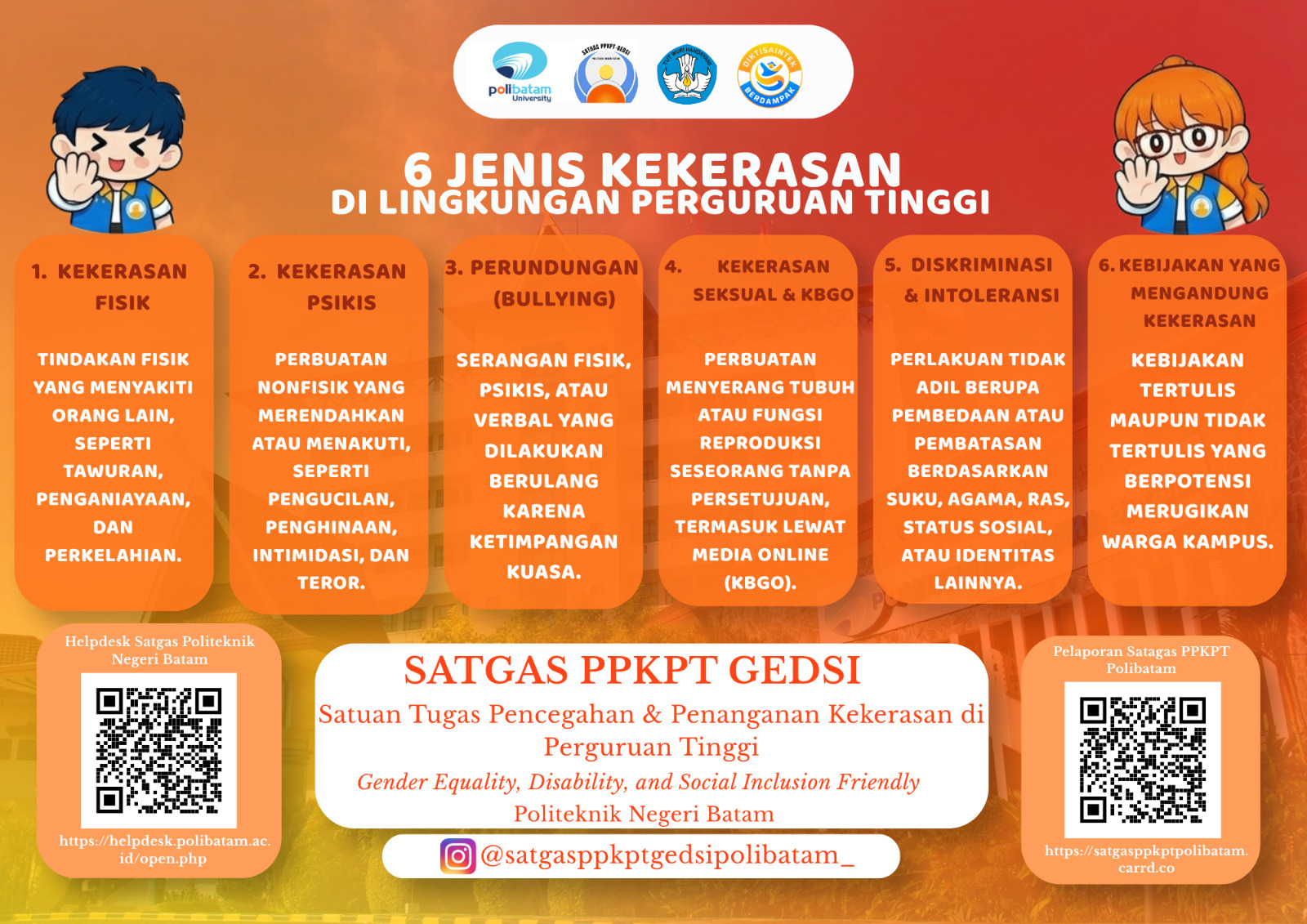
Based on Regulation of the Minister of Education, Culture, Research, and Technology of the Republic of Indonesia Number 55 of 2024 concerning the Prevention and Handling of Violence in Higher Education Institutions, there are six forms of violence that need to be recognized.
1. Physical Violence
Physical violence refers to actions that may cause pain, injury, or physical harm to another person. It may include assault, fighting, brawling, or forcing someone to perform certain work against their will.
2. Psychological Violence
Psychological violence refers to actions that may affect a person’s emotional and psychological well-being. It may include humiliation, exclusion, intimidation, spreading rumors, threats, terror, and extortion.
Although psychological violence may not leave visible physical injuries, it can have serious effects on a person’s sense of safety, self-confidence, and mental well-being.
3. Bullying
Bullying refers to repeated physical, psychological, or verbal attacks involving an imbalance of power between the perpetrator and the victim.
Bullying may occur both in person and through digital platforms. Therefore, the use of social media and information technology should always be responsible, respectful, and mindful of the rights and privacy of others.
4. Sexual Violence
Sexual violence includes acts that demean, insult, harass, or violate a person’s body or reproductive functions without consent.
Sexual violence may also occur through digital media, including taking or distributing private photos or videos without consent, sending unwanted sexually suggestive messages, or committing other forms of harassment through information and communication technology.
5. Discrimination and Intolerance
Discrimination and intolerance may involve distinguishing, excluding, restricting, or treating someone unfairly based on their identity, condition, or background.
Higher education institutions should provide a safe and equitable environment for all members of the academic community while upholding diversity and respecting the dignity of every individual.
6. Policies Containing Elements of Violence
Violence may also arise through written or unwritten policies that have the potential to cause, justify, facilitate, or allow acts of violence to occur.
Therefore, every policy within a higher education institution should be developed by taking into account the principles of fairness, equality, protection, and respect for the rights of all members of the campus community.
Violence can affect a victim’s physical and psychological well-being, learning process, social relationships, and sense of safety within the higher education environment. For this reason, Polibatam encourages all members of the campus community to respect one another, recognize personal boundaries and privacy, and never commit or tolerate any form of violence.
Members of the academic community who experience, witness, or become aware of suspected violence may submit a report to the Polibatam Task Force for the Prevention and Handling of Violence in Higher Education (Satgas PPKPT) through satgasppkptpolibatam.carrd.co. The Polibatam Satgas PPKPT provides assistance in handling reports and is committed to protecting the confidentiality of both reporters and victims in accordance with applicable regulations.
By strengthening awareness of the different forms of violence and fostering collective responsibility across the campus community, Polibatam hopes to continue building an educational environment that is safe, inclusive, equitable, and respectful.
GEDSI Regards – Polibatam Regards!
#Polibatam #PoliteknikNegeriBatam #SafeCampus #StopViolence #SatgasPPKPT #GEDSI #InclusiveCampus #PreventViolence